Google Research has published its most detailed report yet on what teams of specialized AI agents, rather than a single model, can do on problems that have resisted researchers for years. In a post on Friday, the company described results from Antigravity's /teamwork, a multi-agent mode powered by its Gemini 4 models, spanning mathematics, chemistry and software engineering.
The design addresses two familiar limits: a single attempt is unpredictable, and a model can lose track of details over a task that runs for days. Each specialized agent receives only the files and tools it needs, coordinators hand work to fresh successors, and separate critics and auditors challenge results from a clean context. Dedicated checkers do the verifying, from the Lean 4 proof checker to unmodified test suites and hardware counters.
The headline result is in information theory. Researchers from Google, the Chinese University of Hong Kong, the University of Southern California and Carnegie Mellon University used the system's Long Proof pattern to prove the Courtade-Kumar conjecture in full generality. Posed in 2013, the conjecture concerns a random bit string passing through a noisy channel. It holds that no compression of that input down to a single bit preserves more information than a dictator function, which simply copies one input bit. Gemini first found counterexamples to a generalized version, the academic team reduced the problem to a 14-variable optimization, and the models developed most of the new bounds and extended the proof without human input. The team formalized the proof in Lean 4, producing 50 million lines of code a computer kernel can check step by step.
Other teams posed open problems directly to the system. Google says the work closed a gap in adaptive data analysis open since 2014, settled a 2014 quantum computing question, and made progress in optimization and graph theory.
A related framework, /teamwork-LEAP, paired with Gemini 4 Argon, went further into formalization. Google says it fully autonomously produced a machine-checked formalization of the Weil conjectures, the landmark results on counting solutions of polynomial equations over finite fields that Pierre Deligne proved in 1974. That formalization spans about 1.8 million lines of Lean across 28,800 subagent invocations, and the framework also formalized recent proofs concerning Hilbert's tenth problem and finite-time blowup for the Navier-Stokes equations.
The engineering results are easier to measure. The system rewrote libgav1, Google's AV1 video decoder, from C++ into about 170,000 lines of Rust, matched the original in conformance tests, and then made the Rust version 20 to 30 percent faster. A two-week campaign added about 800,000 lines of safe Rust to the Zircon microkernel, passing its unit tests and booting on arm64 hardware. In chemistry, 30 agents reached 95 percent top-one exact match on complex benchmark molecules, nearly doubling single-agent performance.
Google is opening the tools. The /teamwork and /boost workflows and Deep Review are available in Antigravity today, with two free Deep Review calls a week, and applications are open for 10,000 academic researchers to receive six months of free access to the highest tier.
A note of caution is in order. These are Google's own reported results. The Courtade-Kumar formalization is public and has been audited, while the code behind the Weil formalization has not yet been published, so that claim cannot yet be checked outside Google. Even so, the direction is clear: the gains came not from a single larger model, but from teams that produce, criticize and verify each other's work.
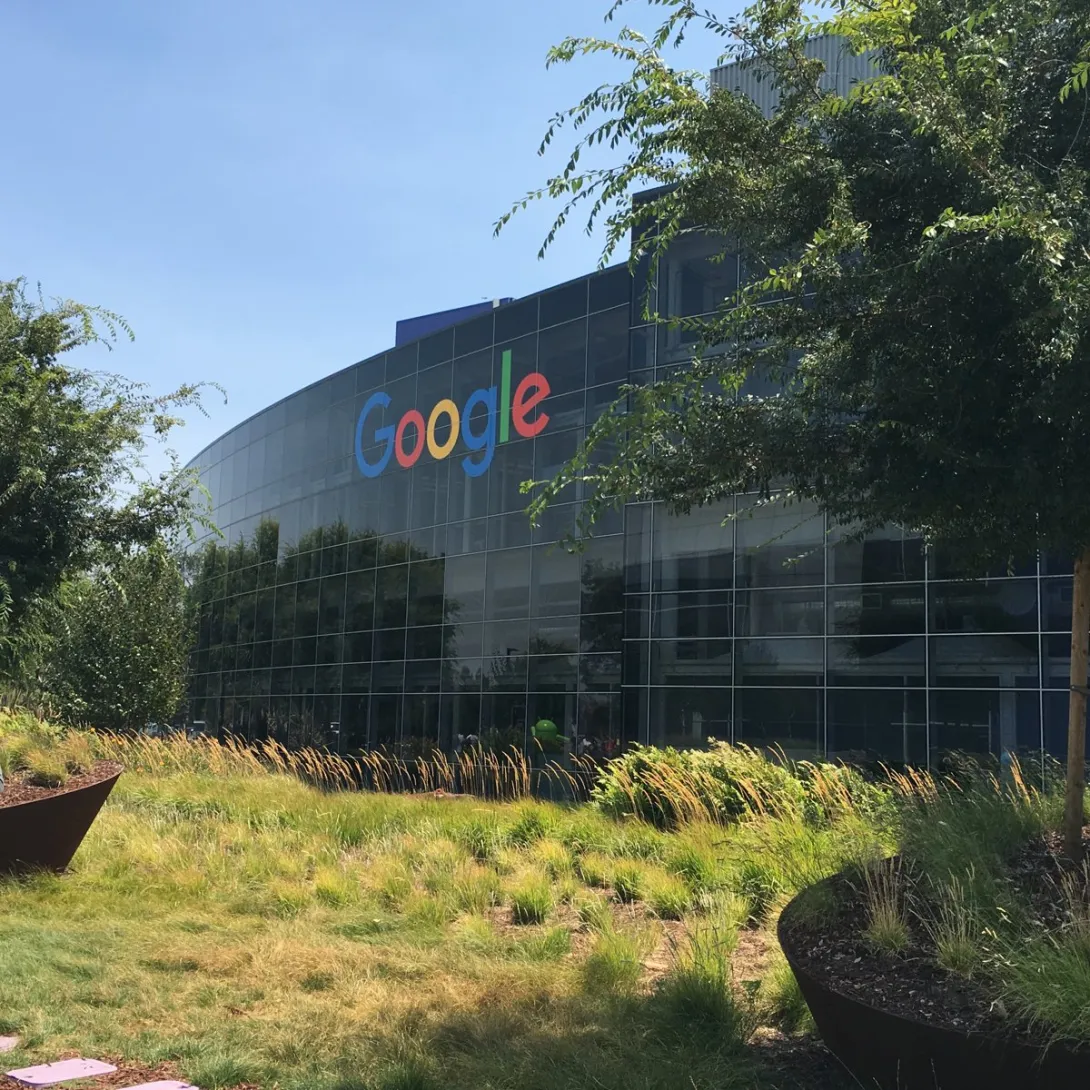
Photo: The Googleplex headquarters in Mountain View, California (Wikimedia Commons, Creative Commons).