SK hynix has posted the strongest quarter in its history, becoming the latest memory maker to show just how much of the artificial intelligence boom runs through a handful of chip factories. The South Korean company reported third-quarter revenue of 104.6155 trillion won, crossing 100 trillion won in a single quarter for the first time, with operating profit of 83.3338 trillion won and an operating margin of about 80 percent. Net profit came to 39.7756 trillion won.
The numbers were records on both the top and bottom lines, and they arrived ahead of schedule in the market's imagination. Revenue rose 32 percent from the previous quarter and 328 percent from a year earlier, while operating profit climbed 38 percent sequentially and 632 percent year over year. It was the company's sixth straight quarter of record results, powered by rising prices for AI memory and a product mix tilted toward its most valuable lines.
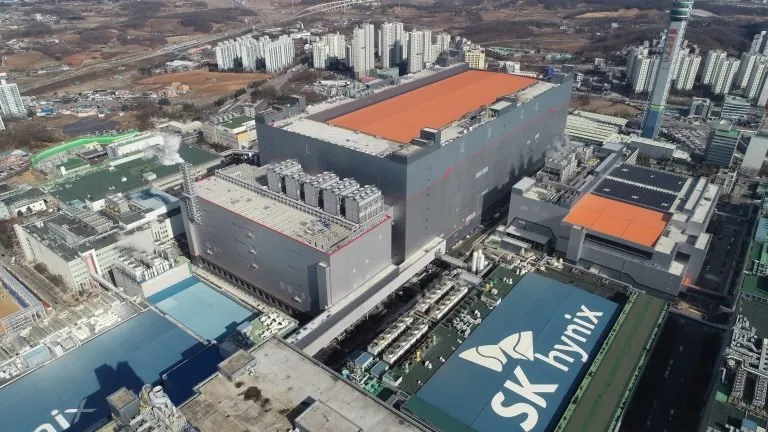
Two product families did most of the work. In DRAM, sales of server DDR5 jumped, and shipments of HBM4 — the newest generation of high-bandwidth memory stacked alongside AI accelerators — began in earnest. In NAND flash, sales of 321-layer enterprise solid-state drives expanded, and high-value data center products grew across the board. The company expects HBM4 to overtake HBM3E in both shipment volume and revenue in the fourth quarter, making it the mainstream product, and plans to ramp its M15X plant to maximum capacity by the end of the year to feed demand.
Perhaps the most consequential part of the release was not the profit but the visibility. SK hynix said it has signed long-term agreements with 14 major customers, including leading global cloud providers, covering more than 50 percent of its total production capacity for 2027 and 2028. The agreements include a mechanism that reflects market conditions within an agreed price range, a structure designed to keep profitability stable while still responding to swings in the market. Executives went further on the earnings call, saying that virtually all of the company's DRAM and high-bandwidth memory volumes over the next three years, through 2029, are effectively sold out.
The company also expects the underlying shortage to last. It argued that a virtuous cycle has taken hold, in which AI-driven productivity gains in areas such as software development, customer service and search encourage wider adoption, which in turn drives more infrastructure investment. As that investment broadens beyond a few large technology companies to general enterprises and national programs, SK hynix expects demand to keep exceeding supply through 2030, citing the technical difficulty of leading-edge processes and the long lead times needed to build new plants. Its balance sheet reflects the moment: cash and equivalents reached 114.5 trillion won, borrowings fell to 15.8 trillion won, and net cash rose to 98.7 trillion won.
Shareholders are getting a large share of the windfall. For 2026, SK hynix plans shareholder returns of roughly 100 trillion won, combining cash dividends of 30 trillion won or more with share repurchases and cancellations of 60 trillion won or more, including most of the gains from its Kioxia investment. The board approved a third-quarter dividend of 14 trillion won and a further 20 trillion won buyback. The results lifted memory stocks broadly on Wednesday, with rival Micron gaining in premarket trading. The message from Seoul is hard to miss: whatever doubts surround AI spending elsewhere, the memory at the heart of it remains scarce, expensive and spoken for years in advance.