OpenAI has disbanded its standalone robotics team for the second time in six years, moving its researchers into the company's main research organization and its applied robotics and hardware staff into its Applied group. Fortune reported the reorganization in an exclusive on November 13, and OpenAI confirmed it when asked, saying the change reflects a bet that general-purpose models have become good enough to control robots directly.
Under the new structure, the robotics research team now reports to Chief Research Officer Mark Chen as part of the main research organization. The applied robotics and hardware teams have moved into the larger Applied organization, which reports to President Greg Brockman. OpenAI has not said how many people were affected, and it has published no announcement of its own about the change.
A company spokesperson told Fortune that robotics remains a core part of OpenAI's long-term vision and portrayed the move as a way to accelerate progress rather than a retreat. Earlier this year, the spokesperson said, researchers assumed the best path for robotics was to build on video models such as Sora. Since then, general frontier models, including GPT-6 Astra, have shown that they can be applied to robotics directly, and that finding prompted the move. A first public demonstration of OpenAI's own humanoid robot, a target Chief Executive Sam Altman has previously set for 2027, remains on the schedule, according to the reporting.
The strongest evidence behind the decision comes from a study by Nvidia researchers, cited in Fortune's report. Given camera images, robot state information and a control interface, an agent powered by GPT-6 Astra reached a 74.8 percent success rate on RoboLab-120, a simulated benchmark of robot manipulation tasks such as picking objects up and moving them. The best specialist model built specifically for that kind of task scored 51.0 percent on the same leaderboard.
Those numbers need careful reading. The 74.8 percent figure came from the study's most supported setup, with persistent history and extra tools; a direct-control setup scored 66.3 percent, and the simplest configuration scored about 50 percent, roughly level with the specialist model. The test ran entirely in simulation, and the simulation paused while the model thought, so it says nothing about real-time control. Results on real hardware were more modest: on OpenAI's StationeryBench test with dual-arm robots performing desk tasks, Astra completed 7 of 100 tasks in full, against none for a specialist rival — a genuine lead, but far from reliable performance.
OpenAI has been here before. It wound down an earlier robotics team in 2020, rebuilt a standalone team in 2024, and partnered with Figure on humanoid robot models, a partnership Figure ended in February 2025 when it chose to develop its own robot AI. Outside experts quoted by Fortune were divided: Carnegie Mellon roboticist Guanya Shi read the move as a sign that robotics is no longer treated as a special problem, while noting that large cloud-hosted models are still too slow for some on-robot work, and MIT professor Russ Tedrake argued that companies with robots already working in real places hold deployment data that grows more valuable as foundation models improve.
The practical test is now easy to state. If a general model can produce a convincing physical robot demonstration in 2027, folding robotics into the main lab will look like the moment the field changed. If that demonstration slips, the decision to dissolve a dedicated team for the second time will face much harder questions.
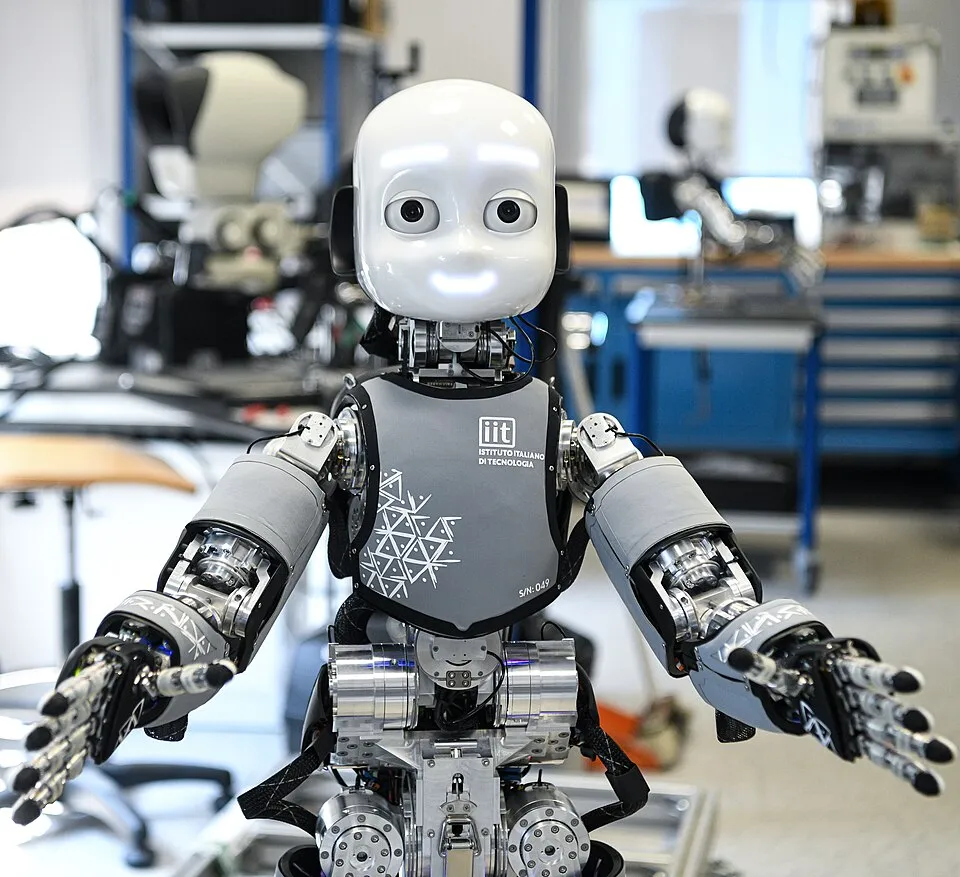
Photo: A humanoid robot at the Italian Institute of Technology in Genoa, Italy, via Wikimedia Commons.