Tenstorrent, the AI chip company led by veteran processor designer Jim Keller, said on Monday that it has closed a 1.5 billion dollar Series E funding round at a 6.2 billion dollar post-money valuation. The figure more than doubles the valuation the company reached in December 2024, and it ranks among the largest single raises by an independent AI chip startup this year.
The round was led by Trace Capital and Innovation X, with participation from Fidelity Management and Research Company, Morgan Stanley, ARK Invest, T. Rowe Price, SanDisk, Cadence Ventures, Tether Investments, Virtu Financial and XTX Markets, among others. Tenstorrent said the new capital will be used to deploy its Galaxy servers at scale, keep serving open-weight models across large language models and video generation, and advance the AI and CPU intellectual property it licenses to customers designing their own silicon, including Samsung and LG.
Tenstorrent's pitch rests on openness. Its processors are built on RISC-V, the open-standard instruction set that lets companies design chips without paying license fees or tying themselves to a proprietary ecosystem. The company sells one architecture at every size, from a single accelerator card or desktop workstation to full racks, linked superclusters and licensed chip designs, and it pairs the hardware with an open-source software stack so developers can run frontier models locally and enterprises can run them on their own premises.
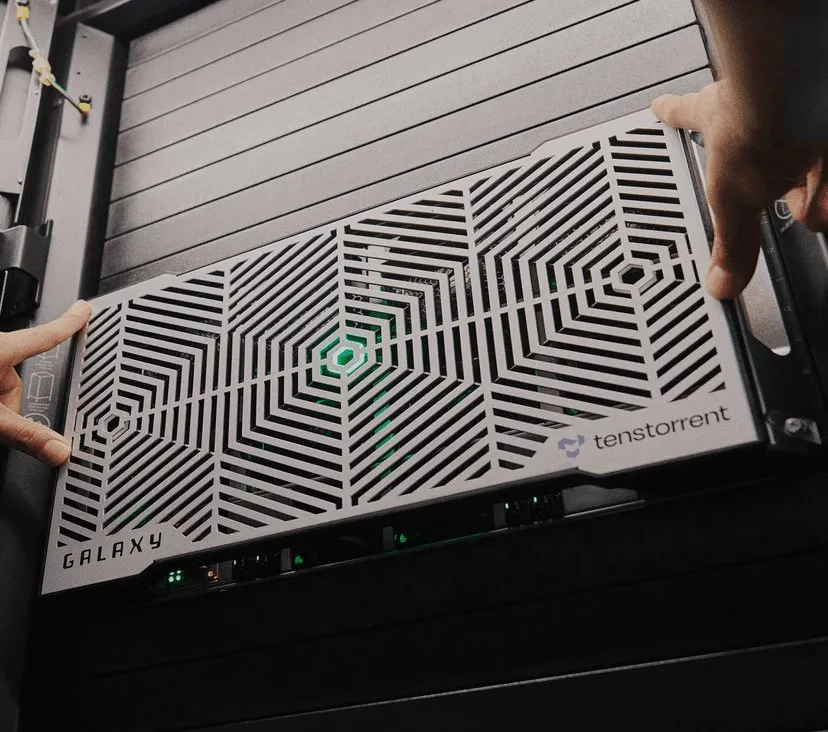
The flagship product is the Galaxy server, which combines dozens of the company's Blackhole processors into a single system for training and running advanced models. Tenstorrent says Galaxy systems are already in use at Virtu Financial, which runs on-premises AI trading agents on them, and that colocation provider Equinix makes the servers available to enterprise customers.
"We built one architecture and sell it at every size," Keller said in the announcement. "The future of compute is open, scalable, and owned by the people building on it."
Keller's track record is a large part of the company's appeal to investors. He is one of the most celebrated chip architects in the industry, with key design roles on Apple's A4 and A5 processors, AMD's Zen architecture and Tesla's self-driving chip. Tenstorrent's previous round, in December 2024, raised more than 693 million dollars at a 2 billion dollar pre-money valuation in a financing led by Samsung Securities and AFW Partners.
The raise lands in a market still dominated by Nvidia, whose chips and software remain the default choice for training and running AI models. That dominance is exactly what Tenstorrent is selling against: buyers worried about cost, supply and dependence on a single vendor have been looking for credible alternatives, and a 1.5 billion dollar war chest gives Tenstorrent the manufacturing and hiring muscle to make its case at much larger scale. Whether an open architecture can convert that interest into broad deployment is now the company's central test.