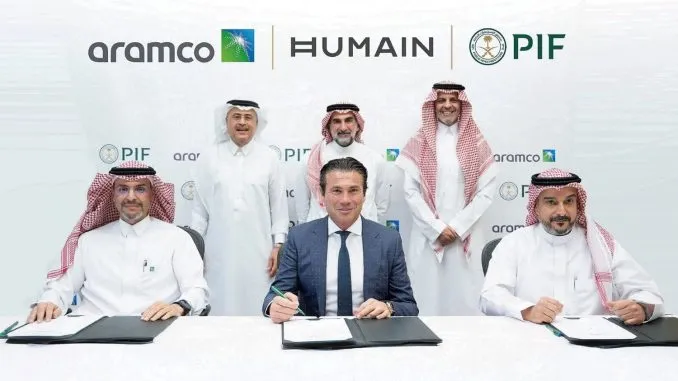
Saudi Arabia has put its national artificial intelligence company under two of the most powerful owners in the kingdom. The Public Investment Fund (PIF) and Aramco announced on November 1 that they have closed a transaction in which Aramco, through a wholly owned subsidiary, acquires a 49 percent stake in HUMAIN, while PIF retains the remaining 51 percent.
The deal is built from assets as well as cash. Aramco will contribute approximately SAR 9.9 billion, about 2.6 billion dollars, in cash to HUMAIN during 2026, in addition to transferring AI, compute and digital assets. Both shareholders say they will contribute AI assets, capabilities and talent, bringing portfolios that had been developed separately under one company.
HUMAIN was launched in May 2025 to build full-stack AI capabilities across four core areas: next-generation data centers, high-performance infrastructure and cloud platforms, advanced AI models, and transformative AI solutions for industry. Its models include ALLaM, described by the company as one of the world's most powerful multimodal Arabic large language models. The headline target is scale: HUMAIN plans to deploy 3 gigawatts of AI data center capacity by 2030 to meet regional and global demand for compute, with the stated aim of becoming one of the leading exporters of AI globally.
For Aramco, the logic is industrial as much as financial. The energy giant expects to use HUMAIN's infrastructure to turn advanced AI capabilities into applications across its own operations and affiliates, while also monetizing the AI and digital assets it has built internally. Aramco President and CEO Amin H. Nasser said the company has achieved 11.3 billion dollars in Technology Realized Value since 2023, with a significant portion coming from AI solutions, and described the partnership as laying a foundation for localizing the AI industry and deploying AI systems faster and at greater scale.
PIF framed the closing as part of its 2026-2030 strategy. Yazeed A. Al-Humied, PIF's Deputy Governor and Head of MENA Investments, said bringing the two shareholders' AI portfolios together under HUMAIN creates a synergy that fuels talent growth, technological advancement and intellectual property creation, and strengthens AI as an enabler across PIF's six ecosystems. In other words, HUMAIN is not being positioned as a single product company, but as shared national infrastructure that other Saudi businesses are expected to build on.
There are still important unknowns. The announcement does not put a total valuation on HUMAIN, does not break down how much of the planned 3 gigawatts is already under construction, and treats the capacity figure as a 2030 plan rather than capacity in service today. The cash contribution is also spread across 2026, so the company's funding will arrive in step with its buildout rather than all at once.
Even with those caveats, the closing matters because it shows how the AI race is consolidating. Rather than funding a scattering of separate state-backed AI ventures, Saudi Arabia now has one national champion co-owned by its sovereign wealth fund and its largest energy company, combining capital, compute ambitions, an Arabic-language model family and a built-in industrial customer. How quickly HUMAIN can turn that structure into operating data centers will decide whether the plan becomes a real export business.