The race to build artificial intelligence computing capacity now has a new financial benchmark. Apollo and Goldman Sachs announced on November 20 that they had priced approximately 44 billion dollars of senior and subordinated notes to fund the purchase of graphics processing units and related equipment for SpaceX. The two firms said the transaction represents the largest GPU financing executed to date, and that strong investor demand left it oversubscribed and upsized.
The money will deliver Nvidia's next-generation Vera Rubin chips for SpaceX's terrestrial compute buildout, the ground-based computing expansion behind the company's AI ambitions rather than its rockets. Lease schedules are expected to commence when the GPUs and related equipment are delivered in the first half of 2027, which means the borrowing is tied to hardware that has yet to arrive and will begin generating lease payments only once it is installed.
The structure shows how the AI buildout is increasingly financed like infrastructure. Financing was committed by funds and affiliates managed by Apollo and Goldman Sachs, with funds and accounts managed by BlackRock, Goldman Sachs Asset Management and capital accounts advised by KKR providing anchor commitments. Apollo Global Securities and Goldman Sachs served as co-global coordinators, while Goldman Sachs acted as sole structuring agent. Apollo was advised by Morgan Stanley, Citi and PJT Partners on the transaction.
Reuters reported the pricing details behind the headline figure, citing a source familiar with the sale. About 25.17 billion dollars of senior secured notes maturing in April 2033 priced at a yield of 8.259 percent, roughly 4.4 billion dollars of senior secured notes maturing in April 2031 were sold at 7.66 percent, and 2.564 billion dollars of subordinated secured notes, also maturing in April 2033, were sold at 8.36 percent. Those yields underline that even the largest AI borrowers are paying a substantial price for capital when the collateral is fast-depreciating computer hardware.
The deal also builds on an arrangement SpaceX disclosed last month, under which an Apollo affiliate would buy AI chips and server hardware and lease them to the company in a transaction with total principal payments of about 40 billion dollars. Apollo partner Jamshid Ehsani called SpaceX one of the most ambitious builders of compute in the world, and said the transaction reflected Apollo's focus on downside-protected, asset-based structures, with origination, structuring, syndication and principal investing working together to deliver flexible capital at scale.
For the wider industry, the significance is the template as much as the total. AI companies need enormous quantities of advanced chips years before the revenue those chips support can be certain, and traditional corporate borrowing is not always the cheapest or fastest route. Asset-based financing of this kind turns the chips themselves into the foundation of the loan, spreading the risk across insurers, pension-style funds and other large investors willing to hold the notes. If deliveries proceed as planned in the first half of 2027, the SpaceX financing will be an early test of whether that model holds up at the largest scale yet attempted.
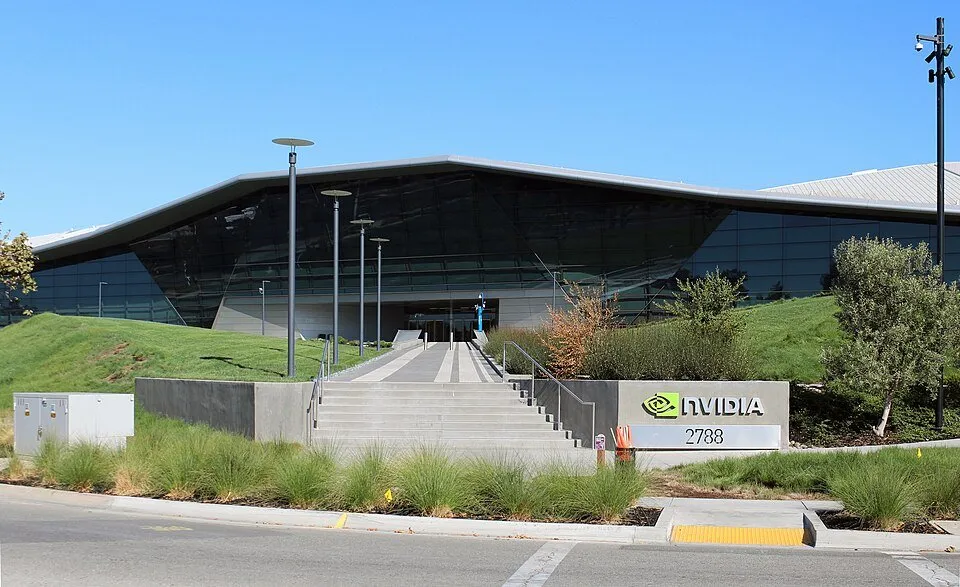
Photo: Nvidia headquarters in Santa Clara, California, photographed by Coolcaesar, via Wikimedia Commons, licensed under CC BY-SA 4.0.